
The last few days have stirred something in me.
A death penalty case that left me wrestling with justice, mercy, accountability, and what Love asks of us in the face of terrible harm. Statements about judgment, hell, and who is ultimately included or excluded. Words spoken by people I deeply love whose lives are often more gracious than the theology they have inherited. And somewhere in the middle of it all, a song I had never heard before found me while I was driving.
None of these things gave me answers. If anything, they have made me more aware of how little I know. But they have also brought me back to something I increasingly trust:
Love always has the last word.
I struggle with the idea that God’s love has an expiration date. We speak of a God who relentlessly pursues us, whose grace is always available, who loves us before we ever know how to respond. And yet much of our theology seems to draw a line at death. One breath before death, redemption remains possible. One breath after, Love can do nothing more.
I find that harder and harder to believe.
Not because I think our choices don’t matter. They matter enormously. Human beings do terrible things to one another. Truth matters. Responsibility matters. Justice matters. The wounds of those who have been harmed matter profoundly. But I am increasingly unconvinced that God’s ultimate answer to what is broken is eternal abandonment.
Lately I’ve been thinking about fire. We have often used fire as an image of God’s punishment. But Scripture also—and often—gives us fire as an image of God’s presence and purification. There is the refiner’s fire that purifies. Christians pray for God’s fire to come, to refine us, purify us, transform us.
What if Love is the fire?
What if encountering Love in all its fullness burns, not because Love has turned against us, but because Love refuses to leave untouched anything in us that is not of Love’s kind? Hatred. Violence. Fear. Shame. Cruelty. The wounds we have inflicted and the lies we have believed.
Maybe the fire doesn’t burn away the person. Maybe Love burns away everything in us that is not of Christ—everything that distorts the image of God in which we were created.
Perhaps judgment itself can be understood this way—not as Love finally giving up, but as Love refusing to give up. Bringing into the light what has been hidden. Naming what has caused harm. Healing what has been wounded. Making right what we cannot make right ourselves.
I don’t know exactly what that looks like, and that matters. The moment I become convinced that I have God, judgment, heaven, hell, or eternity figured out, I may simply have built another box for God—another version of the certainty I sometimes struggle with in others. So I want to hold all of this with open hands.
Somewhere in the middle of these thoughts, while driving and letting Apple Music introduce me to something new, Welcome by The Arcadian Wild began to play.
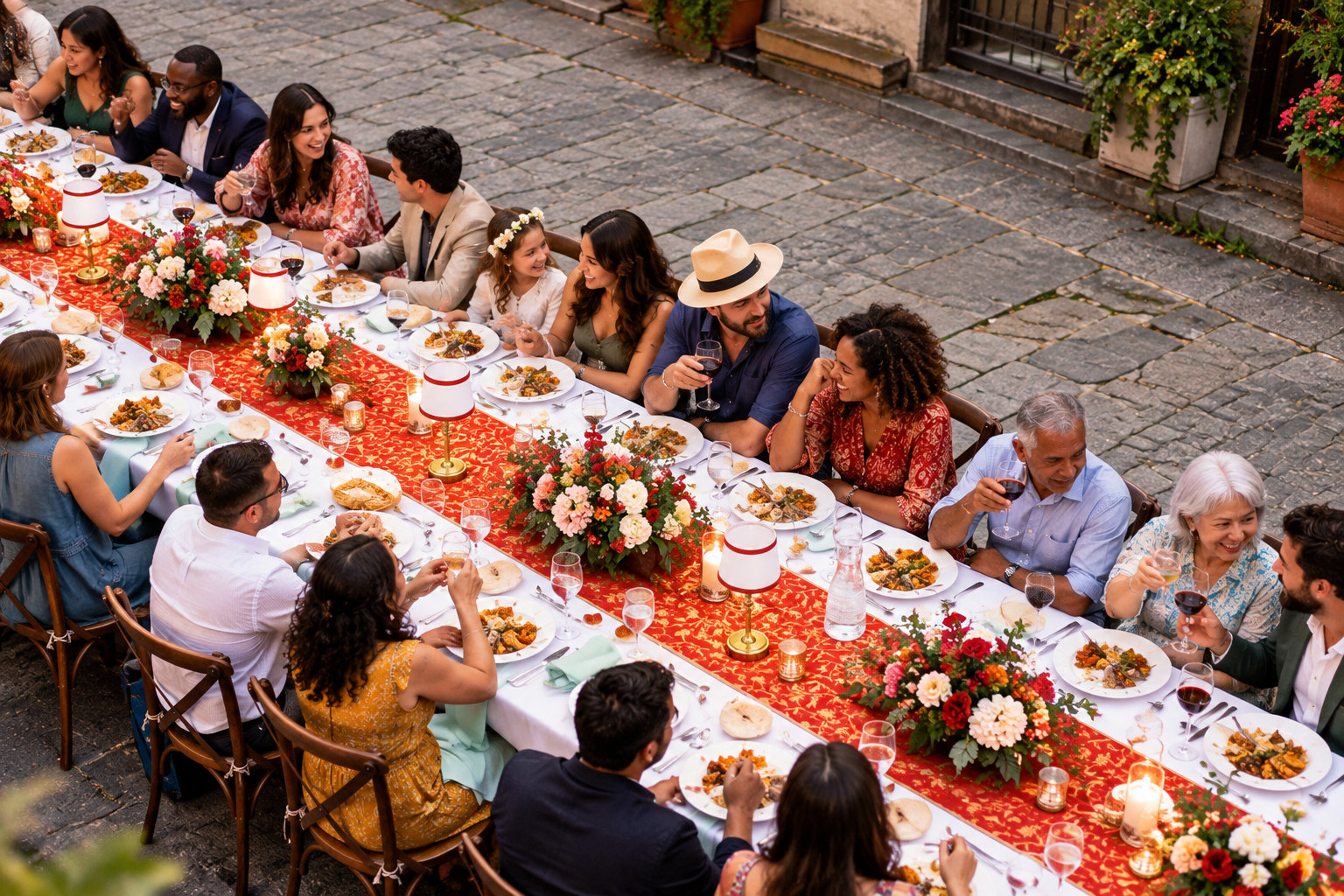
I knew nothing about the song. But I heard a table—people arriving with different stories, joys, grief, and hunger; strangers becoming something more like family; an invitation to receive what we need and share what we have. Eventually the table itself becomes a kind of resistance to darkness and death.
It sounded like something my soul was already trying to say.
And it made me realize just how often the table appears in the sacred story. A wedding feast where more wine is made when the celebration runs dry. Jesus welcoming children others tried to keep away. Meals shared with tax collectors and sinners while religious people questioned the guest list. A table prepared in the presence of enemies. Again and again, the table appears in unexpected places, among unexpected people.
And then there is Judas.
Jesus knew who Judas was. He knew what Judas carried and what Judas was about to do. Peter was there too, about to deny even knowing him. And still there was a place at the table. Still there was bread. Still Jesus washed their feet.
Love didn’t wait for them to understand everything correctly or become someone different before Love moved toward them. Maybe the table was never the reward for finally getting everything right. Maybe the table itself was part of how Love was making things right.
Maybe that is why all of this keeps bringing me back to resurrection.
I have increasingly come to understand the cross and resurrection as something much larger than a transaction determining who is in and who is out. I see Love entering everything we thought could separate us from Love—suffering, violence, betrayal, even death.
And Love refuses to stay dead.
For me, this is becoming one of the deepest revelations of the cross and resurrection. Love doesn’t defeat death by avoiding it. Love enters death itself and defeats its power from the inside out. Death is not where Love stops. In Christ, death becomes another place Love enters.
And this is where the words at the end of Romans 8 have begun to sound even more profound to me. Paul reaches for almost every possibility he can name—death and life, things present and things to come, powers, height and depth—and insists that nothing in all creation can separate us from the love of God.
Not even death.
If God is Love, I find myself increasingly unable to believe that death somehow becomes the boundary beyond which Love can no longer pursue, heal, refine, restore, reconcile, or make things new. How could death become the source of eternal separation when resurrection reveals—and Paul insists—that even death cannot separate us from Love?
I don’t know what that means for eternity. I don’t know how God restores the deepest wounds we have inflicted upon one another or how justice, mercy, responsibility, freedom, healing, and reconciliation ultimately come together. I don’t need to pretend that I do. But I am struck by one of Scripture’s final images: a holy city whose gates are never shut.
Resurrection doesn’t ask me to explain how God will accomplish what I cannot imagine. It invites me to trust the character of the One doing it.
And increasingly, that is where I find myself: trusting that Love does not eventually become something other than Love; that the table is bigger than I imagined; that the fire may be more healing than I realized; and that death cannot accomplish something to God’s Love that resurrection has already revealed death cannot do.
Love was there before I understood it. Love is here now, in this moment. Love will be there beyond every ending I can see. As 1 Corinthians 13 says so simply, “Love never ends.”
Love does not give up.
Death does not have the victory.
Love always has the last word.
——
Song link: Welcome by The Arcadian Wild

Leave a Reply