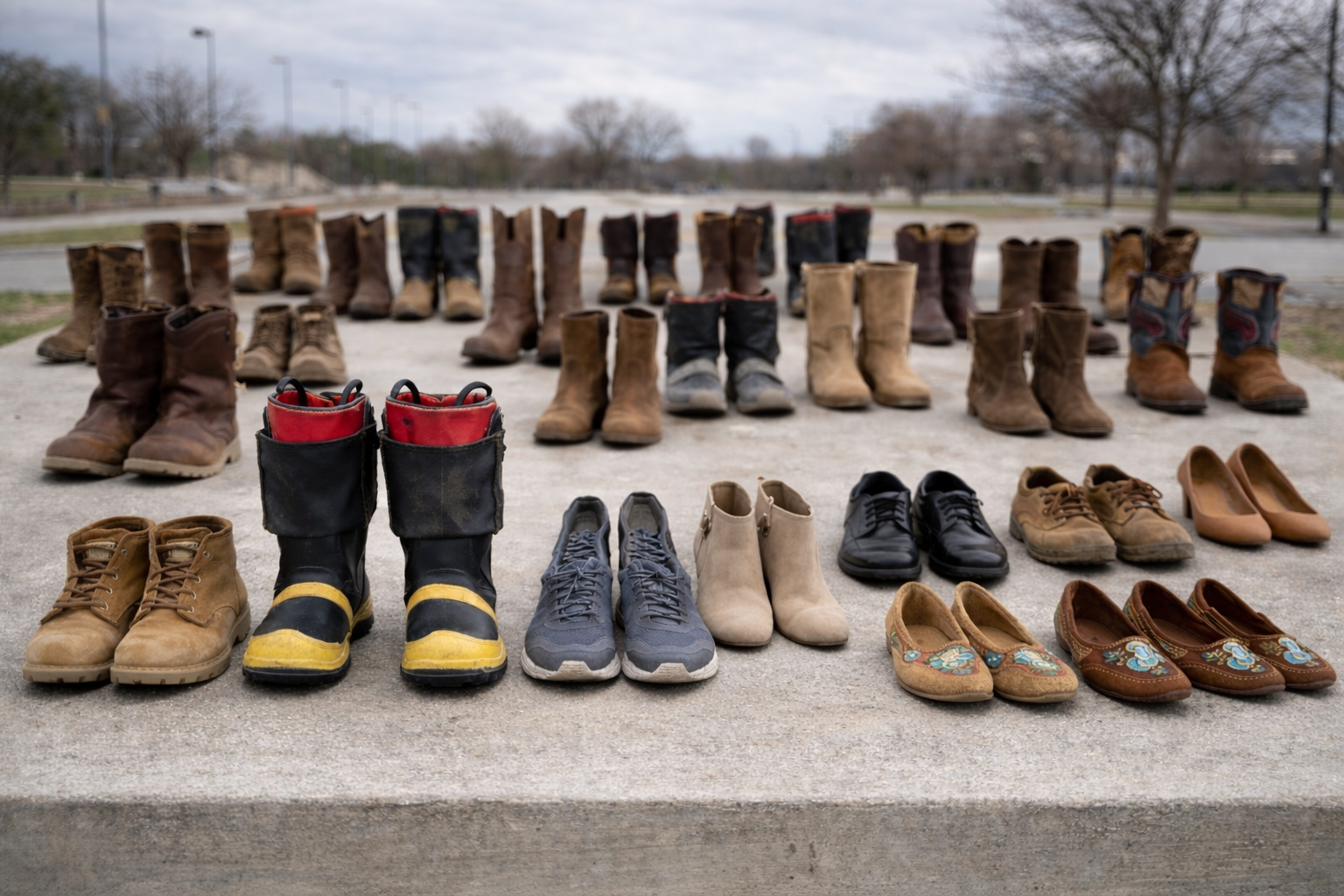

When the call comes, we go.
At the firehouse, the tones drop and whatever conversation we were in falls away. Politics, frustration, opinions—none of it survives that moment. We move without knowing exactly what we’re walking into. Sometimes it’s danger. Sometimes grief. Sometimes the quiet unraveling of a life we can’t fix.
What matters isn’t who we are in the bay, but who we become on scene.
We work alongside people we might see very differently in other settings. We don’t resolve those differences. We set them down. There is a shared mission that holds us—a kind of ground that doesn’t ask for agreement, only presence. I’m often struck by the irony: the words spoken casually back at the station can sound radically different from the care offered when someone is lying hurt in front of us.
And yet, when it matters most, the ground holds.
For a long time, something similar held in the faith community that shaped much of my life.
We were oriented outward—toward help, hope, and healing in our community. We showed up for people whose lives were complex, unresolved, and often painful. Differences existed, sometimes sharp ones, but they didn’t destabilize us. We were held together not by sameness, but by a shared sense of calling that mattered more than being right.
Until, slowly, it didn’t.
Looking back, I can see that what fractures communities is not disagreement itself, but a shift in what we’re standing on. The mission narrows. Certainty hardens. Complexity starts to feel like a threat. And the ground that once absorbed tension no longer does.
That experience is never far from my mind as I watch people I love—both in my firehouse world and in my faith world—attach themselves to leadership that seems, from where I stand, to work against the very values they name as sacred.
But I’m learning that they are not all hearing the same thing.
For some, especially those who have felt managed, dismissed, or quietly shamed by institutions, this leadership offers permission. Permission to speak plainly. Permission to be rough around the edges. Permission to stop translating themselves into language that never felt like home. I understand why that resonates. It can feel like dignity reclaimed, even when it comes wrapped in abrasion.
For others, particularly within the church, the permission is different. It’s permission to feel morally anchored in a world that feels unmoored. Permission to draw lines that promise protection from a feared erosion of meaning. Policy becomes reassurance. Alignment begins to feel like faithfulness. Even when the character of the leader contradicts the moral vision being defended, the sense of standing on solid ground can feel worth the trade.
Both forms of permission offer relief.
And both quietly replace ground with alignment.
Ground doesn’t ask us to agree. It holds us whether we want it to or not. It receives us, resists us, and reminds us of our limits. Permission loosens those limits. It reduces friction. It feels freeing. But it cannot bear weight for long.
What thins, in that exchange, is coherence—the sense that we are still inhabiting the same world together. Words lose their tether. Claims float free. We stop asking whether something fits the shape of what keeps showing up, and start asking only whether it serves our side.
Not reality as a position to defend, but reality as something encountered—again and again—regardless of how we name it. Something that does not yield to certainty or volume. Something that meets us through consequence, through relationship, through the quiet refusal of life to be simplified. Something that includes the full weight of other people’s lives, especially when they do not resolve neatly.
I’ve felt the cost of losing contact with that ground personally.
When faith communities trade shared ground for moral alignment, those who live in complexity become expendable. Walking alongside starts to look like compromise. Listening starts to look like betrayal. I know that fracture from the inside. It leaves marks that do not heal quickly.
What is hardest for me is not disagreement. I have always lived between perspectives. On issues that divide people sharply, I often find myself saying both/and—hearing the concerns my conservative friends name, while also insisting on the dignity my more progressive friends are trying to protect. That middle space has never felt weak to me. It has felt faithful.
But that space depends on something shared. On a ground we do not get to manufacture. On a willingness to stay in contact with what resists us, even when it unsettles our loyalties.
Integrity, in this sense, is not about being right. It is about staying aligned with what keeps presenting itself—with what costs us, with what refuses to be bent into slogans. It is quieter than permission. Slower. Often lonelier.
And yet, it is the only thing I know that keeps us in contact with the ground beneath us.
I don’t know how we recover a shared “we.” I don’t know how we repair what has fractured—politically, spiritually, relationally. But I do know this: a unity that requires us to step away from shared ground will not hold us for long.
My hope—still—is that we might learn to stand together again.
When the call comes, and we go.
When we live with the courage of shared humanity.
Held by the Ground that holds us.
Leave a Reply